In the demanding world of deep-earth drilling and geological excavation, the efficiency of an entire multi-million dollar operation often comes down to the performance of a cutting element no larger than a coin. When drilling through abrasive and unyielding geological layers like granite, basalt, or quartz-rich sandstone, standard drill bits simply cannot survive the extreme mechanical and thermal stresses.For drilling engineers, downhole tool manufacturers, and industrial procurement teams, selecting the best PDC cutters for hard rock is not just an equipment upgrade—it is a critical economic necessity. Choosing the right polycrystalline diamond cutters directly influences the Rate of Penetration (ROP), minimizes costly trip times, and dramatically lowers the overall cost per foot drilled. This comprehensive technical guide explores the engineering behind high-performance PDC cutters, why hard rock demands specialized superabrasives, and how to source the most reliable cutting solutions for your industry.
Drilling through soft shale or limestone is relatively straightforward. However, when a drill string encounters hard rock formations, the physical dynamics of the cutting process change violently. Standard PDC cutters that perform well in soft rock will fail catastrophically in hard rock due to three primary geological challenges.
Formations composed of granite, basalt, and quartz-rich rock are notoriously abrasive. Quartz, for example, is highly abrasive and acts like microscopic sandpaper against the drill bit. This extreme abrasiveness causes rapid tool wear, grinding down the diamond edge and generating immense friction. If the cutter is not specifically engineered for high PDC cutter wear resistance, the cutting edge will blunt quickly, requiring an immediate and costly halt to drilling operations to replace the bit.
Hard rock does not shear away smoothly; it fractures and chips. This creates severe drilling vibrations, often referred to as "stick-slip" phenomena. Furthermore, geological formations are rarely uniform. A drill bit might pass through a soft layer and suddenly slam into a dense nodule of hard rock. These sudden transitions generate intermittent, massive compressive cutting forces that can easily shatter or chip the diamond table of a standard cutter.
The combination of high rotational speeds, immense weight on bit (WOB), and extreme rock hardness generates a severe thermal load. In deep drilling, the friction-generated heat at the cutting edge can exceed 700°C. At these temperatures, the cobalt catalyst used in standard PDC manufacturing expands faster than the diamond, leading to thermal micro-cracking and the eventual degradation of the diamond layer into graphite. Specialized hard rock cutters must be engineered to withstand these extreme thermal envelopes.
To survive the brutal environment of hard rock drilling, a PDC cutter must be engineered with specific metallurgical and structural traits. When evaluating polycrystalline diamond cutters for extreme applications, engineers must analyze the following five factors.
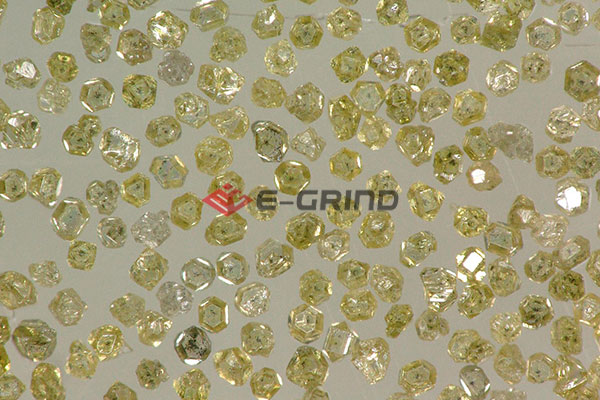
The foundation of any PDC cutter is the raw diamond powder used in its synthesis. The size, purity, and density of these diamond grains dictate the cutter's primary characteristics. As the core structure of a polycrystalline diamond compact, the diamond layer's microstructure directly determines wear resistance, impact strength, and overall drilling efficiency in hard rock formations. A higher density of diamond-to-diamond bonding improves overall wear resistance.Furthermore, the grain size must be matched to the rock type:
Finer grains create a denser diamond table with better surface stability and exceptional wear resistance, though they can be slightly more brittle.
Coarser grains provide higher impact resistance, making them better suited for fractured rock where sudden impacts are frequent. Premium hard rock cutters often use a multi-modal blend (mixing fine and coarse grains) to achieve the best of both worlds.
Technical Insight: Diamond Grain Performance
| Grain Type | Primary Advantage | Best Performance Scenario |
| Fine Grain | Smooth cutting, superior wear resistance | Highly abrasive, uniform hard rock |
| Medium Grain | Balanced performance | Mixed-layer drilling |
| Coarse Grain | Higher impact resistance | Fractured, impact-heavy formations |
Thermal degradation is the enemy of hard rock drilling. To combat the extreme heat generated by rock friction, the best PDC cutters undergo a "leaching" process. This proprietary chemical process removes the cobalt catalyst from the top surface of the diamond table after sintering. A deeply leached cutter prevents thermal expansion mismatches, preventing thermal degradation and maintaining cutting efficiency at high temperatures.
Because hard rock drilling involves sudden fractures and uneven load distribution, extreme toughness is required. If a cutter is too brittle, the diamond edge will chip (spalling), rendering it useless. High-quality PDC cutters utilize engineered microstructures and optimized residual stress management during the HPHT cooling phase. This ensures the cutter can resist chipping and maintain edge integrity even under violent drilling vibrations.
The interface where the polycrystalline diamond meets the tungsten carbide is a critical stress point. The quality of the pcd material and the bonding technology used during manufacturing play a decisive role in preventing delamination and ensuring long-term cutter reliability. Weak bonding leads to delamination—a catastrophic failure where the entire diamond table shears off the substrate. To prevent this in hard rock applications, manufacturers design non-planar interfaces (wavy, grooved, or starburst patterns). This increases the surface area for bonding and helps distribute impact stresses, ensuring stable drilling performance and a longer tool life.
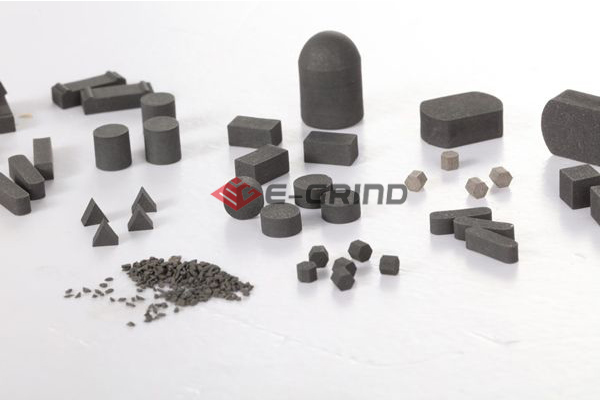
The physical shape of the cutter significantly impacts how it breaks rock. While the standard flat cylinder is common, hard rock applications often require specialized geometries:
Flat face cutters: Used for general shear drilling in slightly softer rock.
Chamfered cutters: Feature a beveled edge that drastically improves impact resistance by removing the fragile sharp corner.
Dome-shaped (or conical) cutters: Designed to plow through rock rather than shear it, offering incredible abrasion control and impact survival in the hardest formations.
Understanding the geometric variations of PDC cutters for drilling formations is essential for optimizing drill bit design. Here is how different cutter types align with specific hard rock challenges.
The traditional flat PDC cutter is designed for aggressive shear cutting. It provides a very high penetration rate. However, because its edge is relatively sharp, it is more susceptible to impact damage. It is best used as a general-purpose drilling cutter in formations where the rock is hard but uniform, without heavy interbedded layers.
Chamfering is the process of angling the cutting edge. A large chamfer (or double chamfer) sacrifices a tiny amount of initial sharpness to provide massively better impact resistance. By distributing the cutting force over a larger angled area, chamfered cutters exhibit reduced edge chipping and are the industry standard for hard, unpredictable rock drilling.
Dome (or conical) PDC cutters represent the cutting edge of hard rock technology. Instead of shearing the rock, the rounded tip acts like a plow, crushing the rock through localized point-loading. They are optimized for the most abrasive formations and provide improved durability when standard shear cutters fail.Comparison of Hard Rock Cutter Types
| Cutter Type | Core Strength | Best Application Use |
| Flat | Fast shear cutting | Soft to medium-hard uniform rock |
| Chamfered | High durability against impact | Hard, interbedded, fractured rock |
| Dome / Conical | Extreme wear resistance | Extremely abrasive rock, chert, granite |
The extreme durability of polycrystalline diamond has pushed its use far beyond traditional drilling, embedding it deeply into multiple heavy industries.
This is the most common application. PDC cutters are the backbone of deep well drilling and directional drilling. They are specifically engineered to navigate through tough, abrasive shale formations and dense caprocks to reach hydrocarbon reserves.
In the mining sector, efficiency is driven by volume. PDC cutters are increasingly replacing carbide in ore extraction machinery and hard rock tunneling equipment, allowing for faster boring through quartz and granite veins with far less tool maintenance.
Geothermal drilling presents a unique challenge: the rock is not only hard but extremely hot. Premium, deeply leached PDC cutters are the only tools capable of maintaining their cutting edge in high-temperature formations without suffering from thermal cracking.
Major civil engineering projects rely on PDC technology for foundation drilling, bridge piling into bedrock, and advanced tunneling engineering (such as TBMs - Tunnel Boring Machines), where hard rock must be excavated efficiently beneath cities and mountains.


 English
 日本語
日本語 한국어
한국어 français
 Deutsch
 Español
 italiano
 русский
 português
 العربية
 tiếng việt