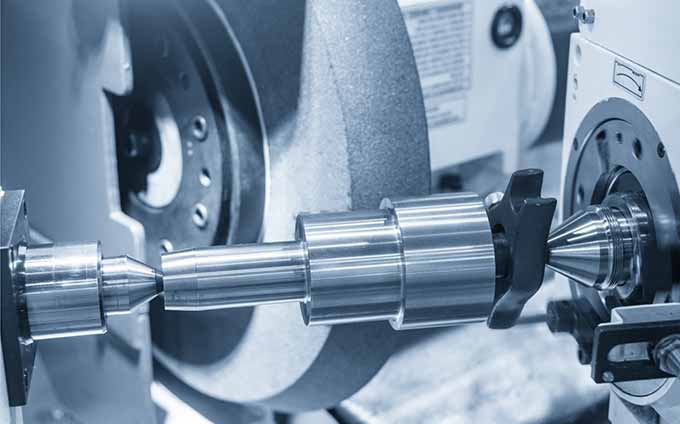
Diamond, the hardest known industrial superabrasive, is widely used for cutting, grinding, lapping, polishing and sawing of tungsten carbide, advanced ceramics, glass, sapphire, graphite, PCD and composite materials. Unlike gem diamond, industrial diamond selection focuses on workpiece compatibility, crystal type, toughness, particle size, bond system, concentration and processing conditions. Improper selection will lead to fast grain wear, workpiece burn, surface defects and poor economic efficiency. This article introduces the core principles and decision-making procedures for diamond abrasive selection in superhard machining.
Diamond is not suitable for ferrous materials such as carbon steel, alloy steel, high-speed steel and nickel-based superalloys. Under grinding heat, carbon atoms of diamond diffuse into iron matrix, resulting in graphitization and rapid abrasive failure. For all iron-based hard workpieces, CBN (cubic boron nitride) shall be adopted instead.
Diamond is the preferred abrasive for non-ferrous hard and brittle materials: tungsten carbide, alumina, silicon nitride, silicon carbide, optical glass, sapphire, lithium niobate, graphite, carbon fiber composites and PCD blanks.
2.1 Monocrystalline Diamond
Friable grade (Resin-bond grade, RB): Moderate impact toughness. Grains produce controlled micro-fracture under load, continuously exposing new cutting edges (self-sharpening). It matches resin bond wheels and loose lapping slurry, delivering excellent surface finish. Widely used for fine grinding and polishing of carbide and ceramics.
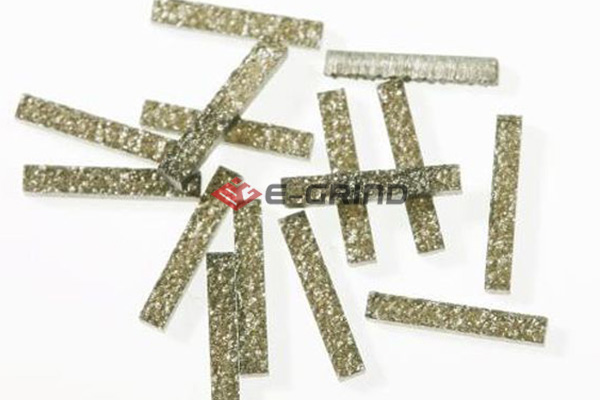
Tough grade (Metal-bond grade, MB): High TI (toughness index) and TTI (thermal toughness index). Grains resist macro-fracture under heavy cutting force. Suitable for metal bond, electroplated tools, saw segments and heavy stock removal processes.
2.2 Polycrystalline Diamond (PCD Powder)
Polycrystalline diamond consists of many nano-sized diamond crystallites bonded together. It fractures uniformly at micro-scale, with low scratch risk. It is used for ultra-precision super-polishing of optical crystals and semiconductor substrates, where high removal rate and nanometer roughness are required simultaneously.
2.3 Coated Diamond (Nickel / Copper / Titanium Coating)
Metal coating improves the mechanical bonding force between diamond grain and bond matrix, reduces grain pull-out, raises tool life. Nickel-coated diamond is the most common option for metal and resin bond systems.
Grit size directly determines material removal rate and surface roughness:
Coarse grit (30#–80#): Rough cutting, sawing, heavy stock removal; high removal rate, rough surface.
Medium grit (100#–240#): Semi-finish grinding, flattening, form grinding.
Fine grit (400#–3000#): Fine grinding and pre-polishing.
Micron / submicron powder (0.1–20 μm): Lapping, mirror polishing, achieving Ra < 0.01 μm.
One principle: multi-stage grinding is recommended. Start with coarser grit for stock removal, then step down to finer grits sequentially to avoid deep scratches from coarse grains in finishing.
The bond controls grain retention and dressing behavior. Three mainstream bond systems:
Resin bond: Good elasticity, low grinding heat, excellent surface finish. Self-sharpening by gradual resin wear. Best for carbide tool grinding, precision finishing. Limitation: poor thermal resistance, easy aging at high temperature.
Metal bond (bronze, copper alloy): Ultra-high holding strength, outstanding shape retention and long service life. Suitable for aggressive grinding, sapphire, ceramic rough grinding, wire saw beads. Disadvantage: difficult dressing, easy to clog without proper coolant.
Vitrified bond (ceramic bond): High porosity, good heat dissipation, easy dressing and truing, stable geometry. It is the growing choice for high-volume precision grinding of advanced ceramics and semiconductor components.
Electroplated diamond is a special single-layer structure, for complex profile forming and one-pass machining.
Concentration means diamond content inside the bond matrix. 100% concentration equals 4.4 carats/cm³.
High concentration (100%–125%): Long tool life, good profile holding, used for form grinding and fine finishing.
Medium / low concentration (50%–75%): Larger chip space, sharper cutting, lower heat, preferred for rough grinding and high stock removal.
Even with correct grain and bond grade, speed, feed rate, grinding pressure and coolant will change performance:
Dry grinding is generally forbidden; sufficient coolant suppresses graphitization and thermal crack.
Too high peripheral speed causes thermal damage; insufficient speed leads to grain crushing.
After grade selection, small-scale trial is mandatory. Evaluate four indicators: material removal rate, surface roughness, wheel/grain wear and workpiece subsurface damage. Adjust toughness, grit size or bond hardness if chipping, burn or fast pull-out occurs.
1. Confirm workpiece material → Judge diamond or CBN
2. Define process: rough grinding / finish grinding / lapping / sawing
3. Select diamond crystal type: tough monocrystalline / friable monocrystalline / polycrystalline / coated
4. Select grit size according to allowance and target Ra
5. Match bond type and concentration
6. Set coolant and grinding parameters
7. Conduct trial test and optimize grade
Industrial diamond selection is a systematic matching between workpiece, abrasive grain, bond and grinding process, rather than simply choosing a brand or particle size. The core balance lies in toughness, self-sharpening property, grain retention and thermal stability. Rational selection can maximize removal efficiency, control surface quality and reduce overall processing cost.


 English
 日本語
 한국어
 français
 Deutsch
 Español
 italiano
 русский
 português
 العربية
 tiếng việt